
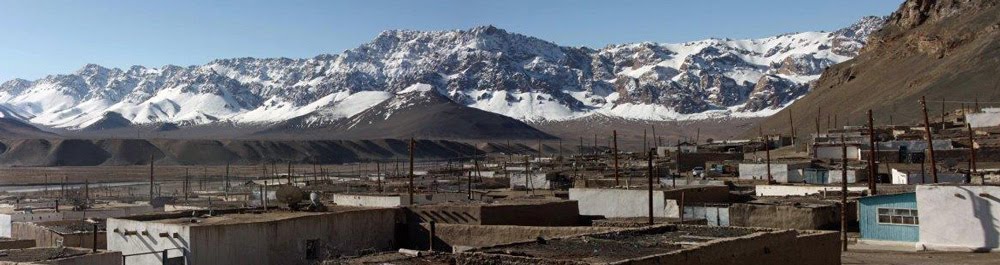
Murghab Nurkap (Beam of sunlight).
The Eastern Pamir is a remote high plateau all above 3000m and with Peak Lenin being the highest mountain at 7134m. The region is bordered by China to the east (via the Kulma pass – soon to open to international tourists), Kyrgyzstan to the north (via the Kizil -Art pass) and Afghanistan to the south. Murghab is the regional centre of the Eastern Pamir. Founded as a Cossack base in 1892, ‘Pamirsky Post’, it soon became a town for ethnic Kyrgyz nomadic herders and traders and was called Nurkap (Beam of sunlight). Supposedly, when Tajiks heard this they misinterpreted the name as Murghab (River of the Birds) because they’d seen a flock of ducks fly up at that moment. Murghab is a high-mountain district in the eastern part of Tajikistan located at an elevation of 3600 m above sea level. Vegetation is scarce on such elevation, and those rare trees are well taken care of. Climate there is rather severe with very dry air, strong cold winds and high UV. 40°C (degrees Celsius; 104 °F, degrees Fahrenheit) in summer and -40°C (-40 °F) in winter are typical.
No one would actually think of building a village in such rough conditions, but at the time of the Great Game, when Russian and British empires were struggling for the influence in Central Asia, Russian troops arrived there in 1892 and organized a frontier post. It was called Shadjan post. First, they built small houses to survive harsh winter, and later continued with other constructions. This is how the history of Murgab began. Few years later, Russians established a frontier post in Khorog. As a result, Shadjan post became less significant. Later, Murghab village became one of the points on Pamir Highway and served as a center of geological exploration in eastern part of Tajikistan. Today Murghab is a must-stop place for travelers, as there is no other populated settlement for hundreds of kilometers where it would be possible to stay for a night in relatively comfortable conditions.
Population of Murghab is around 6300 people represented by Pamirians and the nomadic ethnic Kyrgyz. During high season, you can always meet around 150-300 tourists from around the world traveling along the Pamir Highway.
Murghab – Background
In 1892, as a consequence of event surrounding ‘The Great Game’, a Cossack encampment was established known as ‘Pamirsky post’. The local ethnic Kyrgyz herders and traders saw this as an opportunity and soon they established a village surrounding the post. The village became known as Nurkap, meaning ‘beam of sunlight’, however, when Tajiks heard this name it is suggested that they reinterpreted it to ‘Murghab’, meaning ‘River of the birds’, having seen a flock of ducks rise from the valley. That name stuck. However, Murghab still does catch the sun far more than most of the surrounding districts due to the geography of the mountains – suggesting the correct naming in the first place.
Murghab – Dining Scene
As you will quickly learn, Murghab is not a centre for the gastronomic arts. With a very poor standard of living the local community have little need for ‘eating out’ experiences and a visitor’s best hope for sustenance is either through their home-stay / guest house or by visiting one of the cafes down in the bazaar. Cafe Nuris is perhaps the pick of the options, with a number of discrete booths and a wider selection of menu options than might first appear. However, it’s always best to ask what they have on before you look at the menu and get disappointed! Try Beshbarmak – the Kyrgyz national dish.
Murghab – Things to Do Murghab itself is not a beautiful town. Rather it is more functional for the 12000 or so local people that inhabit the Eastern Pamir and who get supplies and meet in this hub for the region.
In terms of things to do the main local attractions are ‘Murghab House’ which is run by ACTED and is at the Osh end of town (in fact the last place in the town). Currently it isn’t fully occupied and is underutilised for tourism purposes although it does perform some local functions.
The bazaar is perhaps the most interesting place to visit although more for novelty rather than for any particularly aesthetic reason. It consists of a few rows of old containers that have been re-designed to provide shells for shops. It is worth going in a morning to catch the shoppers and see life as it is in the town from a local perspective.
Whilst Murghab might not be a good reason to spend time off the road, it really is a good place to take day trips from, out into the wilder parts of the Eastern Pamir. Places of interest include:
• Rangkul with its beautiful lake. You can also take camel excursions from Rangkul into the sand dunes. Rangkul music school is also worth a visit if you can pre-arrange a performance (they do dance, music and poetry reading)
• Karakul is further afield and if you are travelling the Pamir Highway then you might already be going there – it’s certainly worth a stopover as the views in the morning light over the lake can be stupendous.
• A long day off-road trip down to Shymak is interesting as it take you to the furthest south-eastern corner of Tajikistan and close to the Chinese:Afghan:Pakistan borders right at the eastern end of the Wakhan. You won’t feel more remote than in Shymak.
• Beyond Shymak is the Zorkul national park where you will need a permit. To get down there involves more than a day out but it is worth an excursion to see the lake and perhaps a herd of Marco Polo sheep that are much more prolific in these mountains.
There are shorter excursions and trek routes close to Murghab that are all interesting and offer opportunities to see petroglyphs, cave paintings and more remote hamlets. Check out a local tour operator or the META office for details.